

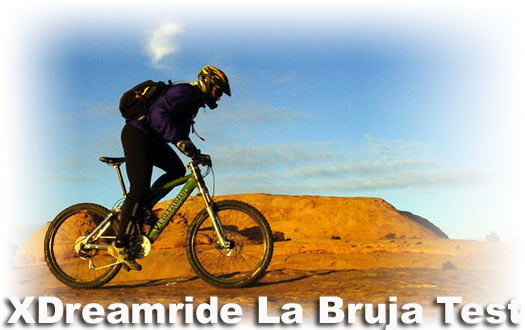
This is a journal of testing for XDreamride Edition Ventana La Bruja research written by Lee Bridgers.
Pictures by Lee Bridgers and Jerry Daniels.
PROJECT COMPLETED ON 4/30/03 ~ UPDATED 10/22/03 ~ DREAMRIDE FULLY OFFERED 12/03 ~ MUTANT OFFERED 7/05 ~ BRUJA RECOMMISSIONED 10/07
This test is a compliation of notes on research and performance spanning from December of 2002 to October of 2003. What you read below is a written history of a project. Some of the research remains behind passwords to keep the badmouthing down in front of the kids. More recent conclusions come first in the log.I came upon a fellow on the trail days ago, noticed a Karpiel on his roof and stopped to admire another Sherwood Gibson frame (those Karpiels were made my Sherwood). I let the fellow ride my La Bruja XDT. As he rode my bike up and down a rough hill, I discovered that the Karpiel was sporting the very frame that set a speed record of 96 miles per hour a few years ago. It had been broken, welded, and heat treated three times, but was still being ridden. When the fellow returned, his friend asked what kind of bike the La Bruja was and he replied, "It's a real downhill bike that you can pedal."
Everyone remarks about how amazing the La Bruja looks, but when you get on it and you are a rider who can appreciate what it can do, WOW!
After riding three seasons on the La Bruja XDT, only using it for specific trails where it excels, this bike has taught me a lot. I have three bikes I cannot do without. As a guide, the Bruja XTD is not an option on some trails. It just HAS to go fast, but due to its weight, is slow on the continuous up. It requires training and agression to take advantage of its performance level. Right now, at the time I am writing this, I am fit enough to ride it on medium to long distance Moab cross country rides, and still be able to get up and ride the next day. If used for a specific purpose and allowed to be its own machine, the XDT Bruja is perfect. In near extreme situations it effectively overcomes abstacles with momentum. It is uniquely agile for a freeride bike in tight situations, which is why it is a beast of a trailbike. When compared to the pigs that most freeriders surf around on, the Bruja XDT is a short board. In the right environment, it gets you from point A to point B in a real hurry. If the terrain is rolling, it is going to freak you out. It loves steep G-out transitions and jumps. It demands that you take advantage of gravity, mass, and momentum to eat rough rocky terrain. This bike is more like the feel of a good MX bike than any other mountain bike I have ever ridden. It has perfect weight and balance for the Slickrock Bike Trail, but only if you choose ITS line. In the saddle or over the bike it feels light and stable at slow speed due to a low center of gravity, but demands speed, so you gotta pedal. You have to get the thing moving. Overcome inertia and gain momentum. It will teach you the tricks. On the Slickrock Bike Trail I found the XDT Bruja to be most efficient at speeds that scare the crap out of tourists. It is best not to use it when there are a lot of people on the trail.
The continuing log below of time spent with this project should give you a good idea of what I go through with each frame I choose to build into one of our DSE bikes. This one is my personal favorite. I find great joy in the fact that I live in a place where it can be put to good use. The work formulating and buidling this bike into a personal favorite gave me a deep understanding of how to build a La Bruja frame for other riders. Most importantly, I know where to put the weight to put the frame to good use.
The Ventana La Bruja frame is #1 choice for extreme rough trail, freeride on Moab slickrock terrain for anyone who can push it. There are other bikes that can handle it, but the La Bruja is like a queen among dirtbags. The XDreamTrail build is a tad lighter than true freeride to move it a bit more toward being a trailbike. The most appropriate build for true freeridiing is the XDreamride. While this frame is brutally strong, we do not recommend it for flopping off of a huge 40' cliff or for specific kinds of downhill racing. A small cliff is OK, sure, even a big one, but the La Bruja is really a handling bike, not a flopper. It is to be used on those long distance runs that involve pedaling. Ski lifting is fine. It would be a fine downhill racer on some courses, but you'd be missing the point. It is a real choice for hardcore mountain biking, North Shore trail freeriding or for a heavy experienced rider, because it has perfect geometry, pedals efficiently and handles like a light trail bike. This bike is for someone who wants to ride.
SEARCHING FOR THE HEART OF THE WITCH
(this insert dated 5/2/03)
The bike in this test was built for me. Over the period of any test, which can run on for as long as a year, I experiment with parts looking for the sweetspot where components and frame blend into the bike perfect for a specific purpose, and this 5'10" 180 pound rider. Tests like these determine a basic formula, allowing each build to offer options within the kit, taking into consideration the frame and rider needs. For example, I used a Marzocchi Super T on this bike during the first four rides, arguably the best fork for hardcore freeriding or jumping. The testing of the T was a success in that it confirmed that the bike certainly capable, but was way beyond my needs. I replaced the massive Super T with a Manitou Supernova, then went through three more forks before finding the sweetspot. During the test I tried a custom Stratos El Jeffe, a Romic off of an old Dare frame, and an even longer stroke FOX DH shock for the rear, to give me more travel and a higher bottom bracket. This was a disaster for my wallet. The XDreamTrail version of this very frame now specs a slightly shorter axle to crown fork to create a quicker handling, lighter rough trail bike. But, it depends on who, how and where you ride as to what I would recommend to each individual customer. The realm of La Bruja is certainly rough trail and "freeride" of all types. This bleeds over into extreme trail bike use, depending on the trail, and extreme stunt use, depending on the stunt. The frame is very capable and should be considered for basic XC use if you are agressive enough to have a history of frame failures, are a heavier rider, or simply want a bike with the handling qualities of the Bruja's low center of gravity. If you like speed over rough terrain, or, in my case, on slickrock, La Bruja is a great choice-- for the North Shore, especially, but also a good choice for rough high desert southwest trails when the rider likes to go fast and grab air. It is a fine handling and pedaling anchor on a long, long climb, but worth the effort when the trail goes down and you get to use Mr. Newton.
Late on December 10, 2002 we received our first La Bruja frame to build up and test. I had talked Sherwood Gibson into sending me one because I had a magazine guy coming to Moab. I was going to put it under a good rider and take some pictures, maybe get the thing in a magazine. I had two guides coming in from Fruita to assist. I had reserved the dates on my calendar. The date for all this to happen was December 10th. The magazine guy didn't show. Our hired guides didn't show up. I was left holding my dick . . . . and a La Bruja frame. Not bad, really. I like riding by myself, playing with my dick and building up exotic bikes.
 The La Bruja, out of the box, was an unusual delight. The paint was like eating cake. Bright green cake. The craftmanship is as good as it gets. I expected the welds to be good, but the well-engineered beef at pivot junctions, the awesome bottom bracket yoke, the tasty polished aluminum and elegant anodizing, all were very pleasant surprises. I held the frame as I kinda-watched Exodus, . . . the entire four hour film. I couldn't put the damn thing down. The details in the bearing mounts, the impressive strength of the design, the smooth paint. I had one of those "moments"--you know the kind--when you realize you are in the presence of something special. I knew that if I could make this thing work as good as it looks, I would be very happy. This just might be the bike we needed to for the true freeride category.
As I repeatedly ran my fingers over every smooth centimeter of the slick bright gold green metal flake paint job, I began to take in the placement of pivots, the shock mounts, the cable guides. So much detail. So much smart design through obvious experience. Every single piece of this frame is jewelry. I recalled Sherwood asking me over the phone, "Remember the good old days?" Holding the Bruja frame in my hand I realized that I had found someone who had not let go of the art of the mountain bike. This frame has the same love in it that the first Breezer frame possessed.
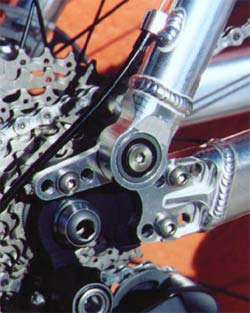
About those adjustable length chainstays: Take one look at this part of the bike (above) and the hard work and dedication of Sherwood Gibson are evident. This feature is real piece of engineering that combines with all other features of the frame to be art. Both dropouts are removeable and adjustable. The left dropout is the disc brake mount. The right is the derailleur hanger. The tolerances in these small parts is just amazing. Break or bend one and just replace it.
In the shop the next morning I shoved a seatpost into the frame (good, solid, tight fit--the DKG collar is awesome) and mounted the frame on a workstand. I knew this bike needed strong stuff and it didn't take long to head straight for the XDreamride parts. The first real decision required that I put wheels and a fork on it to measure head angle and bottom bracket height. I put my first choice Marzocchi Freeride QR-20 on the front. I had some XDreamride wheels in full black with 2.5 tires waiting. With the wheels and fork on the frame, I placed it on the floor. I measured the headangle at 69 degrees. I measured the bottom bracket height at 13"--from the ground to the BOTTOM of the shell.
So, I thought I had found my first problem, at least with the 5" travel fork: I needed at least 13.5" of bottom bracket height at the shell. It is a requirement for my personal bikes, but not necessarily for the XDreamride kit in general. Some people need a lower BB. I need a high one. I am pedaling around MOWAAB over big rocks, on steep sidehills. I took off the Marzocchi Freeride and grabbed a Super T out of stock. Two more inches of travel meant an unsagged head angle of 66 degrees and 13.5 inch BB height. It also meant a hell of a lot more weight up front.
This initial impression of the bb height was later proved wrong. Since the La Bruja does not sag as much as expected, the bb height came in just fine with a five inch travel fork. It took a few days of lugging the Super T around to finally give up and accept a shorter fork, but I was pleasantly surprised. Read on.
This bottom bracket thing has been a campaign of mine. Moab-specific. This penchant originally grew from riding a 1996 Manitou FS frame with a custom four inch travel fork. With a 14 inch bottom bracket height, I grew to love it for riding over the huge ledges and rocks, and for slickrock sidehilling. I put longer forks on XC bikes to make the bb higher. Hitting a pedal in some of the situations I ride through is not an option, so I eventually went to a DH frame which had a perfect BB height with a five inch travel fork on the front. I learned to raise or lower the bb with the shock preload or a longer shock. With every bike, but a rare handful, I have to adjust the geometry of the frame in any way I can to get the BB up. I have been customizing DH frames, running longer shocks that produce 9" of travel, but the idea is more to lift the rear end, not particularly to get more smoosh. I run the largest tires that work on any bike, unless I need to lessen rotating mass for climbing or long distance. I generally like to run the longest travel fork I can stand to tote around. So, this La Bruja frame, by virtue of the Super T, was going to be a pedaling Moab freeride bike, an extreme surfer.
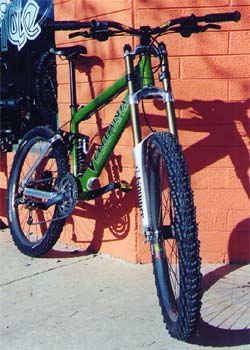 Since all of the parts for the 2002 XDreamride kits were right in front of me, the bike went together in matter of a couple of hours. I used a complete 2002 XTR drivetrain. There were Hayes brakes that I had bled and modified a year ago to have stuff ready for this kind of build at any time. The heavily massaged wheels were built and mounted on another XDreamride bike hanging from the ceiling. I yanked those things down--King hubs, DT 14/15 black spokes, black brass nipples, Mavic 321 rims, bolt-on solid rear axle, 20mm front axle. 2.5 WTB Weirwolf tires. Hutchinson Latex DH tubes.
Any cable routing job is usually a headache the first time you run a frame, but, because of the thoughtful design, the La Bruja was a piece of cake. I am a perfectionist with cable routing. I hate captured cable, "through-the-frame" stuff, twisted lines, overlaps, little adapters. This bike is the best I have ever seen, honestly. It is possible to run completely uncaptured cable on a La Bruja frame. The top mount guides give you the option of running full housing front to rear (captured) or regular open cables (uncaptured). The guides on the shockstay are for open-only, but one could easily drill them out to run housing all the way to the rear derailleur. North Shore boys should like this. Since the bike went together so fast, I was able to do the finishing touches and have it ready for a long ride the next day. I attached clear vinyl sheet wherever cables rubbed paint or the chain would slap. I ran a wide strip down the top of the top tube under the exposed cables because I like to sit up there. This paint is worthy of protection. This bike is going to last, so those stickers are going to be valuable sometime in the future. This is a work of art.
The disc brake hydraulic line is led to the back of the bike through welded-on fittings, basically opposing hooks which grab the cable like two fingers--without capturing it. These work fine, but the cable slides around a lot. The guides at the caliper were absolutely the only design-burp I could find. The hooks should be reversed to keep the cable from being dislodged as it bends away from the caliper. Man, I really had to look hard to find something to complain about. This is all I could find. I used carefully placed and fitted zipties to button down the cable in a few choice points to keep it steady and noiseless. It looks mean. I made sure to use green zipties, whenever there was a need. I also put a green top cap on the Chris King headset, along with a green washer. Green valve caps. Nice touches.
Said and done, the complete bike weighed 37 pounds TOTAL--with all the things I needed to put on it, worthy of the abilities of the frame and fork, and my Time pedals.
FIRST RIDE ~ ROCK SOLID
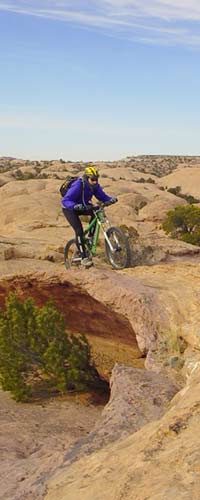
I'm sitting here with my fleece, tights, knee pads and bike shoes still on, with the first ride on the La Bruja under my belt. The New Belgian Brewery Trippel is in a glass beside me. I am ready to let you know just what I think. The first thing I have to say is that this is a very tight package. It looks tight, feels tight, and when you get it into some hairy stuff, it IS tight. The build is obvioulsy suited perfectly to this platform and the bike fits me perfectly. I am going to have a lot of fun selling these bikes, and FINALLY, A REPLACEMENT FOR THE 2000 DARE. The La Bruja is not just a replacement, it is a much better bike for the purposes that most people would want a Dare for. It is heavier, but hidesight tells us that the 2000 Dare was too light. It is not as pedal efficient, but it's hard to complain when its so hard to care about the difference when you experience the control of a more rigid long-travel bike with fine and efficient pedaling. It is much more laterally rigid, not just "much more" but worlds apart. It feels like a solid sports car. Instant response. The La Bruja is the tightest long travel package I have ever thrown a leg over.The first ride I usually take a test bike on is into the Sand Flat Recreation area where I use bit of the Moab Slickrock Trail to gain access to some more technical areas to freeride. I have to climb up about seven hundred feet in three or four miles on pavement just to get there. I cranked down the compression adjusters on the fork and shock, put it in the big chainring and headed up the climb out of the saddle. No bob, no hesitation. Didn't feel like 37 pounds on big knobbies.
I want to jump to the place in the story where the La Brujas becomes THE bike we were looking for, but first, I will tell you how it climbs, first. The initial section of slickrock I encounter travels up the edge of a steep fin. I have to pedal that 37 pound "pig" up something that requires that I kiss the front tire to keep the front wheel on the ground. If you have ridden the Moab Slickrock Trail, you know what I am talking about. I had to grab a 24X30 cog, where I usually grab the 34X34. The front end was surprisingly steady. The head angle was manageable. With that amount of travel in the fork, lean out over the thing and the head angle gets drastically steeper. Ahhh, the magic of long travel.
Because I like a high bottom bracket, I set the Fox DH shock's preload to keep me a bit higher off the ground, starting with less than an inch of sag in the rear. As the ride progressed, I backed off preload to give the bike about 2" of sag. The soft ratio of the shock really makes those small adjustments effective. The tall fork sags a couple of inches on flat ground, taming the slack head angle quite a bit. It feels like it is around 68 degrees. With the compression damping adjustment it doesn't feel too sloppy in tight uphill steep stuff. Compression and rebound damping on both ends are excellent! The new Marzocchi forks are incredible! When the new Marzocchi Freeride 6" singlecrown comes out, it will certainly be the perfect fork for the La Bruja for most people.
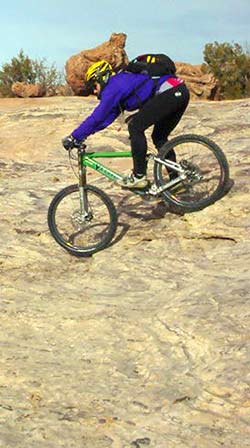 You know, I have been spouting the pedalling efficiency party line for years. I am a lot more familiar with how things work than most of the people in this industry, so I had preconceptions prior to the ride. One preconception was born out. I knew that the way I had this bike set up that it was not going to be as plush as other long travel bikes I ride, bikes so plush that you have to custom tune the fork to be ridiculously spongey to balance the ride, and learn a different riding style to manage fore-aft weight shifts. I began by putting a stock 2003 Marzocchi Super T on this bike knowing full well that the rising rate of the fork would probably match the rising rate of the rear end. It worked. I liked the way it worked to produce a very responsive bike.
The La Bruja was rock solid on the steep smooth climb--rock solid and HEAVY. As I got to the rougher stuff I found that I had no problems going up and over the same nasty ledges and loose rock that I routinely ride on a much lighter bike. I quickly adapted to the bike's unique torque pattern and managed to climb the most difficult sections. No pedals were whacked. No wheels slipped. No pedal kickback. I grabbed a lower gear when it got really steep and pedaled through. I remember that I was thinking at the top of that fin that I was certainly glad I brought this thing up here because I am really going to enjoy going down the steep descent.
The first big drop is a great test to separates freeride bikes from the XC bikes. I rolled down and slammed through the abrupt transition. The rear end sucked it up in a very predictable pattern. I could feel the shock circuits start and stop working, so I hauled the bike back up the rock to see what would happen if I dialed them differently, specific for this obstacle. I was able to go down this hill with different shock settings and eventually tuned out the most harsh elements of the transition. Dial out the compression, back off the preload, dial in the rebound, and the most extreme v-out transition on the ride all but dissappears with body english. No initial hit on the shock. No feel of quick release of the spring. The suspension controls on this bike are simple and extremely effective. The frame design totally takes advantage of the adjustability of the shock.
I continue on to the next section, a steep rock slab where Jeeps drag sand onto the rock, creating a mountain bike sliding board into a sand pit. Once you hit the beach sandy bottom, you've got to go hard left to aim at the near vertical face of a rock to be able to use it as a huge berm to shoot you across more sand to another huge rock. I rode this section with more confidence than ever, even with WTB Weirwolf tires that are horrible on smooth sidehills, let alone those with sand all over them. I brought them along because I knew they would slip (and because they were on the wheels and I am lazy). The stiff frame hung in there when a tire slid, allowing me to regain traction by simply lifting the square cornering edge away from the rock. The frame remained pointed in the direction I wanted to go. Amazing.
A bit more sand and a lot more rock, a very bumpy ride through a camping area, a steep smooth dirt road climb, and I was on the downhill side of the ride. This is the place where the La Bruja became THE FRAME OF THE YEAR, and this complete bike became THE BIKE FOR MOAB. There is a three mile stretch of extremely rough, steep, fast trail. Axe blades. Ridges in every direction. Hit them wrong and its the bicycle on the railroad tracks trick. I have ridden this section of trail on many, many different bikes, some with more travel than this La Bruja XDreamride. I went down the roughest section of trail faster than I had ever been before, feeling in more control. I stopped to tune the suspension to the exact frequency of the vertical ax blades I was striking in the trail. I used a certain section where the bike bouced a bit. I pedaled back up, dialed the rebound damping in a bit on either end, bounced the bike up and down, backed out the preload a bit more, then did the section again and noticed a huge difference. It is amazing the control that the new shock technology gives us when put on a bike designed to make take advantage of it.
On the road downhill heading home I noticed how well-balanced the bike was. It really feels perfect for my body and the needs of speed. It is very tight in every regard. Going 45 miles an hour on pavement, the bike feels like a small motorcycle, tight, stable and predictable. It would be even more stable on this descent with an adjustment in wheelbase, WHICH IS POSSIBLE. With the La Bruja, I could change the wheelbase on the trail, if I wanted to.
After this first ride the only thing I have to do is tighten the Chris King hubs. I just got word from Sherwood Gibson that 8" rotors are good in the rear, so I will be putting one on and replacing the Weirwolf with rounder, meatier rubber. Perfect for rock surfing. The XDreamride La Bruja is destined to be a great surfboard.
CLICK HERE FOR DAY 2 OF THE VENTANA LA BRUJA TEST

Copyright Dreamride LLC. No material, written, graphics, or photographs on this website, may be reproduced, broadcast, published, re-written, re-edited, or re-used in any way outside of this site without written consent of Dreamride LLC and Lee Bridgers. Use of this site signifies agreement to terms of use.