NAVIGATION, HYDRATION, EQUIPMENT, FOOD AND CLOTHING, PACKS AND CONTENTS, NIGHT RIDING, MORE ON WEATHER
[Previous] [Safety Homepage Index] [Next]A July 2005 update: A 15 year old girl recently lost her life on Porcupine Rim due to heat stroke and dehydration. The BLM responded by placing a sign at the toll booth, reading, "Heat kills!" No shit. It has always killed and it will continue to kill innocent young ones along with those who should know better. I mention this not only because it is pertinant, but it is rumored that those involved stated that, "Everything was done right." Well, in this author's humble opinion, somebody screwed up and no one ever wants to take responsibility for such a horrible event. Reading the existing weather conditions and knowing when NOT TO RIDE are important skills to have. Heat truly kills. Avoid it by riding at night, very early in the morning, or just don't ride when temps are over 100 degrees.
It is impossible to over-emphasize the importance of hydration. When it comes to navigation, water is a huge factor. People who come here from non-desert climates are always surprised that so
much water is needed in the heat of summer. Trust me when I say that the
suggested amounts listed here are the absolute minimum, IF YOU KNOW WHERE YOU ARE AND
WHERE YOU ARE GOING! If you are new to the trail, take more. Every year
mountainbikers loose their lives from lack of water and poor navigation
skills. Don't let yourself be put in the frightening situation of being
lost or injured with little or no water. The powerful thank you note at the top of this Safety Section of the Dreamride website is testament to what can happen when unprepared cyclists get lost in canyon country. The two Iowa boys in question died of dehydration after taking a wrong turn on the Porcupine Rim Trail in August of 1995. They eventually tried to hike down into an inaccessible canyon, using up what little strength they had left. Their bikes were stolen, leaving no record of where they were last with them. The boy's bodies were found three weeks later when a rain storm washed one of their packs out from under a rock. The item was spotted from the air by a search and rescue copter. The same kind of situation on the same trail took the life of another young boy in August of 2000.
Always be prepared to spend the night in the desert or mountains. Carrying a little extra weight or spending money on a guide could save your life or at least make a bad situation liveable. Here at Dreamride we constantly listen to the praise of our guests as they come to realize that what we offer is a valuable public service, not just great mountain bike rides.
On the trail, a fanny pack or backpack are necessary items. Hydration systems that double
as a backpack are the best. If you are a Dreamride client or simply want the best hydration system available, we carry comfortable Ultimate packs that can carry 96 oz. to as much as two gallons of water. Come by our Moab office at 59 East Center Street to purchase a pack suitable for the ride. Mention this website and get a 10% discount.
Always carry enough tools to do repairs on your
equipment. Choose components that are reliable and serviceable with minimal
tools. Always carry sunscreen, lip block (dry weather is a shock to those coming from the coasts), a small first aid kit, and a rain jacket.
WEATHER, WEATHER, WEATHER -- ISSUES WITH COLD AND DAMP
We are tired of riders showing up with an absolute minimum of gear, especially clothing, spouting all kinds of macho crap about how they can handle weather extremes with little or no water, hardly any clothing, and/or absolutely no rain gear. We do not cancel a ride because someone is not prepared for foul weather, though we may eject the offending party for safety's sake. If it is raining and the guide determines that it is OK to ride (lightning is the determining factor, not rain), then off we go. You are ready, or YOU ARE READY. If you are not ready for cold or wet, tuff titty--you will be staying in town. NO REFUNDS FOR BEING STUPID! You can beg, borrow or buy extra clothing, but you'd better hurry. If you are not prepared, it's not because we didn't warn you. We are riding. Others may be waiting for you. Refusing to carry enough clothing not only endangers the rider himself, but others in the group, so a refusal is tantamount to saying, "I am an idiot who wants to die alone," which is fine.
Why is the issue on the "Navigation" page? Try getting a person with hypothermia ten miles back to the road. We can tell you it is much easier to just tell the idiot that you don't want to be his babysitter when the shan hits the fit. Why do people not carry enough water? Because they can always ask you for some. Don't be a pack mule for a jackass!
If you are riding in spring or fall, take an extra layer consisting of tights, fleece top, fleece headband or beanie, rain jacket, heavy socks and suitable gloves (an extra pair of dry gloves can be like having Jesus with you on the trail to forgive you for not having faith in the mystery of nature). Morning weather can be deceptive. It may be clear, but things happen fast in the desert. Remember that temperatures may drop 50 degrees, if you encounter a sudden storm. Huge gobs of hail can stick like wet snowballs all over your body and equipment. This can cause an extremely rapid advance into hypothermia. For winter riding wear a thin full body underlayer, tights, fleece upper, and ALWAYS carry a waterproof outer layer. In Moab winter is a good time to whip out the body armor and pads. While 125 degrees during the summer is possible, 20 below zero during a winter night is
not uncommon. Sometimes the desert weather does what it wants to do at the
most absurd times. Even summer nights can see freezing temperatures. It can snow in July. The
higher the altitude the more extreme the changes in weather. Carry supplies
that will enable you to make a small fire. A Bic lighter is a handy tool--having two is even better. On the underside of Juniper trees you will find a stringy bark that makes
for a perfect fire starter even in the rain (you can also find scorpions there, so pull it off with a glove on). Juniper berries are like eating a Christmas tree when you aren¹t particularly hungry, but quite delicious when you are starving. Pinon pine breaks clean when it is dead and dried, so you do not need an axe to cut it, just bang it hard on a rock. Pinon nuts are awesome to eat--do you like pesto? Desert grasses stuffed into a rock crevice can double as insulation and bedding. Get next to rock to protect yourself from the wind. Build a fire against a rock wall to reflect the heat and deflect the wind. Heat large rocks in the fire to place against cold parts of your body or to warm an injured rider.
KNOW HOW TO BACKTRACK
Know your equipment. Always check the bike before you ride and continue to check it. This is especially
important on trails with a lot of rattle, shake, and "exposure". Make sure your bike
is free from defects that could strand or injure you in the middle of the desert, or
dump you off a cliff. Check for frame cracks and stress fractures in components.
Check your tires for tears and your brakes for misalignment that could rip
your sidewalls. Check the quick releases to make sure they are tight. Lube the chain repeatedly and do not shift under pressure. Shifting under pressure weakens your chain and, if it snaps, you could break a bone or be thrown off a cliff edge. Check your suspension
forks. Have you tweaked a wheel on a jump and it's a bit out of round? THIS IS DANGEROUS! Always carry a pump, an extra tube or two, a patch kit, a few large
zip ties, a bit of duct tape, a chain tool, allen wrenches, and a tire boot
to mend torn sidewalls--a dollar bill or energy bar wrapper will do. If you make the mistake
of riding across cacti (bad environmental form) you will be glad you have
two extra tubes and may wish for a third. If you blow all your tubes you
can stuff your tires with grass or brush and zip tie them to the rim to
get home. By the way, brakes don't work on zip-tied rims.
Bottle cages must be able to hold your bottles over rugged terrain. A few
years ago a young woman lost a bottle on Bull Canyon Trail. She was using
flimsy plastic bottle cages, and on a long downhill run one of the bottles
fell out onto the trail. She drank her only remaining bottle of water and
when she became dehydrated she did the right thing--sat in the shade
and waited to be rescued. A 4WD party found her hours later, dehydrated
and exhausted. They had found the water bottle she lost and the first thing
they said to her was, "We found a water bottle. Is it yours?"
She said, "Yes, give it too me. I'm very thirsty." They said,
"Oh no, we have some ice water. Here have some." She drank the
ice water, went into shock and died before they got her off the trail. True story.
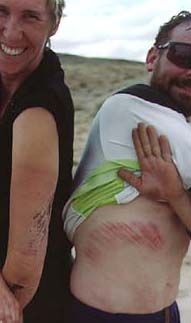 If you are traveling via motor vehicle into the desert to ride your bike, be sure to take extra precautions. Expect to have a flat. Expect to get stuck. Cover all bases. Take a come-a-long hand wench and a shovel. Make sure your spare is OK. Have you checked your gas? Do you have extra water (that means five gallons)? Do you have extra warm clothing? Do you have food? Are your lug nuts tight? Are you prepared to spend the night?
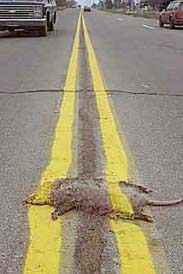 Beware of the lure of slickrock expanses and unmarked trail spurs. It is
very easy to get lost, even if you have a map and can see your destination. Know your limits, know and carry a map, compass, and cycle computer. Global Positioning Systems (GPS) are great if you know how to use them. A GPS doesn't replace on-the-ground navigation skills gained from experience, but they are excellent in case of a helicopter rescue. Combined with a cell phone a GPS unit can make Search and Rescue's job as efficient as possible. If you learn the unit extensively it can help keep track of your course, but it is little or no use when it comes to route finding unless you have a guidebook with coordinates listed with mileage. Note: If you are using a cell phone around Moab you will have to be able to see the La Sal mountains in order for it to work. Constantly
check your position with the map as you ride. Keep track of land marks and
trail spurs. Most Moab area trails are fair to poorly marked, or not marked
at all. People have been known to intentionally mess with signage to confuse newcomers, so beware. Some trails may require quite a bit of scouting and route finding.
Allow time for this. When in doubt, backtrack! Memorize your treads, so you can follow yourself back out. Place cairns (stacked stones) if you need to, but
don't always trust previously existing cairns to take you on the right trail.
Cairns are sometimes placed by people who are lost, just like you.
Beware of the lure of slickrock expanses and unmarked trail spurs. It is
very easy to get lost, even if you have a map and can see your destination. Know your limits, know and carry a map, compass, and cycle computer. Global Positioning Systems (GPS) are great if you know how to use them. A GPS doesn't replace on-the-ground navigation skills gained from experience, but they are excellent in case of a helicopter rescue. Combined with a cell phone a GPS unit can make Search and Rescue's job as efficient as possible. If you learn the unit extensively it can help keep track of your course, but it is little or no use when it comes to route finding unless you have a guidebook with coordinates listed with mileage. Note: If you are using a cell phone around Moab you will have to be able to see the La Sal mountains in order for it to work. Constantly
check your position with the map as you ride. Keep track of land marks and
trail spurs. Most Moab area trails are fair to poorly marked, or not marked
at all. People have been known to intentionally mess with signage to confuse newcomers, so beware. Some trails may require quite a bit of scouting and route finding.
Allow time for this. When in doubt, backtrack! Memorize your treads, so you can follow yourself back out. Place cairns (stacked stones) if you need to, but
don't always trust previously existing cairns to take you on the right trail.
Cairns are sometimes placed by people who are lost, just like you.
Stuff to take with you on a day ride in Moab--the absolute minimum for warm season rides:
1) lots of water (100 oz. minimum) and around 16 oz. of energy drink or fruit juice
2) a good helmet
3) full finger gloves
4) rain shell (garbage bags work--cut holes in it for your arms and head--emergency panchos work, too, but the best tool is a real Gortex jacket with a hood)
5) space blanket
6) an all purpose bike tool kit, like the Cool Tool or the Alien--know what your bike requires and add to the kit as needed
7) two spare tubes, a patch kit, and a pump
8) a tire boot (a dollar bill works just fine--a plastic library card is better), duct tape and zip ties
9) a small flashlight and holder to mount it to your helmet or bars (duct tape works)
10) a lighter and/or matches (keep 'em dry)
11) two or three energy bars
12) a compass and a map--Do NOT rely on guidebooks, unless it is Mountain Biking Moab by Lee Bridgers!
13) a friend and at least one brain
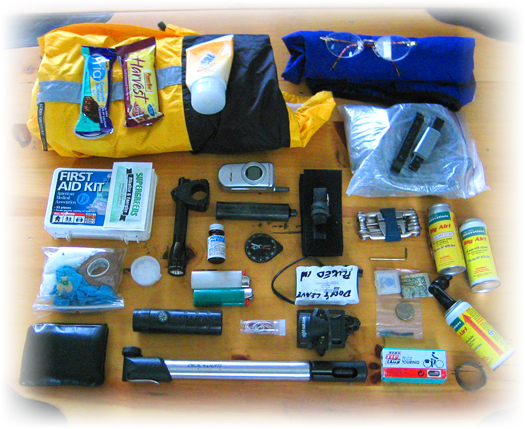
The first aid kit includes, among other things, tweezers (for cactus spines), safety pins, various ointments for insect bites and cuts, sterile pads, sponge, wound closure strips, moleskin (for when blisters start to happen--duct tape works, too), Ibuprofen and a couple of other alternatives to aspirin, lots of aspirin, an emergency poncho and space blanket, and a bleeding wound kit.
Moab Night Riding Tips
1) Don't even consider riding a trail at night if you have not ridden it during the day--more than once.
2) Try to stick to dates around the full moon and choose nights with little or no cloud cover. Darkness is great when you have the light, but if it goes out, you get lost, or accidents happen, the moon is a great friend. I prefer to ride at night in the open during the full moon because I can turn my lights off and still see where I am going. Full moon light is beautiful when it hits mounds of slickrock.
3) Know your equipment. Use reliable lighting systems. HID technology is great for racing--the lights are bright and burn for a long time on a charge, but they are unreliable and expensive to own and operate. A brief loss of power will shut down an HID light a lot faster than you can say, "Where the hell am I?" Not so a Halogen. I recommend NightSun lighting equipment for reliable operation, ease of maintenance and relative low cost. They too have lights with HID lamps, but they include them with Halogen lamps for redundant systems. NightSun's Team Issue dual beam light system is the best on the market when you consider ease of operation, reliablity, cost and brightness. NiteRider's Digital Headtrip is the best helmet mounted light in the business, but opt for the Halogen, not the HID. If you use an HID helmet light, just be sure to only use it by itself when you are going slow or uphill. On descents or over technical terrain, use the HID helmet light in combination with a bar mounted light. Get the upgraded battery, if one is offered. More battery time means more time on the bike. HID lights should NOT be turned off during your ride. Just let that puppy run. Turning an HID lamp off and on does damage to the bulb. It will last a long time, if you don't repeatedly turn it off and on. If an HID lamp dies, you will find out that a good portion of an HID system's high cost is based on the vastly more expensive HID bulb.
4) Riding at night during a race is not like riding at night on your own or with friends. Ride with a buddy. Take an extra light in your pack, always. Take care of each other by riding in each other's beam. If you are running Halogen, when possible, alternately turn lights off and use each other's beam for guidance. This will enable you to go farther and conserve light for when it is needed.
5) I see more rattlesnakes in one night ride than I do in a year's worth of day rides. You will see a lot more wildlife because most desert creatures are nocturnal, and people are not making a racket with their 4WD's, ATV's and Motorcycles, so the animals are not as stressed. Kangaroo mice are everywhere. Try not to run over the little guys. They tend to dash out in front of you just as you come on them.
6) On the trail a helmet mounted system is not better than a bar mounted system. The helmet light on its own flattens terrain, sending shadows BEHIND obstacles, not allowing you to judge their height and proximity. Use the helmet light to point into turns. Use the bar mounted light as your main beam. A helmet light is best for wildlife viewing because it illuminates what you are looking at.
7) Don't point your helmet light at your buddies. It is annoying and blinding.
9) Don't make a shitload of noise. It is bad enough that humans are so inconsiderate of wildlife. Nighttime is the only time these beings get a break. Be quite out of respect.
10) It can get really cold at night in the spring and fall, and sometimes in summer. Take extra clothing. It will get colder as the morning hours approach.
11) If you ride through crypto at night, chances are you will come upon a rattler. I hope he takes a good bite out of your leg.
VISIT THE SKILLS INDEX FOR ON-LINE SKILLS TIPS.